Specialized Breast & Body Contouring Center in Seoul · Dedicated 1:1 International Patient Concierge


Articles
Can Hip Shape Be Fixed After a Poor Surgery? Yes—Here’s How
Unhappy with the results of a past hip surgery? Learn how expert revision techniques at Dite Plastic Surgery in Seoul can correct poor hip contour, restore symmetry, and create natural, lasting curves — even after failed fat grafting.
Schedule a ConsultationCan Hip Shape Be Fixed After a Poor Surgery? Yes—Here’s How
if you're reading this because you're unhappy with the results of a past hip surgery, you're not alone. At Dite Plastic Surgery in Seoul, we regularly consult with patients who’ve undergone fat grafting or body contouring elsewhere, only to feel disappointed by uneven curves, unnatural contours, or volume that simply didn’t last.
The good news? Yes, hip shape can be fixed after poor surgery. But it requires more than just adding volume — it demands strategic correction, anatomical understanding, and customized reshaping.
Let’s break down why hip revision is one of the most complex — and transformative — procedures in body contouring, and how we approach it at Dite with both precision and artistry.
What Patients Mean When They Say “Bad Hip Surgery”
Not all surgical regrets come from dramatic complications. In fact, most patients we see aren’t dealing with surgical errors — they’re frustrated by underwhelming or asymmetric results that don’t match their goals or body type.
Here’s what we often hear in consultations:
- “The fat didn’t stay — my hips went back to how they were.”
- “It looks uneven — one side sticks out more.”
- “My hips are wide but square — not curvy.”
- “I feel boxy from the front or too flat from the side.”
- “It doesn’t match my waist or thighs.”
In many of these cases, the original surgery was technically ‘successful’ — but aesthetically unbalanced. That’s where revision comes in: not to start over, but to refine what wasn’t finished.
The Anatomy of a “Good” Hip Contour
Before fixing, we need to define what we’re aiming for.
In Korean beauty standards — and increasingly worldwide — a well-shaped hip is softly rounded, with a smooth transition from the waist, and natural harmony with the thighs and glutes. It’s less about width and more about proportion. The ideal silhouette doesn’t scream surgery — it enhances the natural hourglass line without distortion.
A strong hip contour typically includes:
- Volume on the hip dip zone (just below the iliac crest)
- Sufficient width to balance shoulder and thigh ratio
- Smooth transitions from front, side, and oblique angles
- No sharp edges, dents, or overfilled zones
Unfortunately, poor surgical planning often misses this. Either fat is placed too high, creating a bulky upper hip, or placed too shallow, leading to fast resorption and collapse.
Why Revision Hip Contouring Is Different — and Demands More
Correcting a poor hip augmentation isn’t just a repeat of the first surgery. It’s a reconstruction of both shape and tissue quality. Here’s why it’s more complex:
1\. Scar Tissue and Irregular Fat Layers
After an initial surgery, the fat layers may be fibrotic or uneven. Scar tissue can block new fat from integrating properly or create visible ridges if not released.
At Dite, we use multi-plane fat dissection techniques and cannula-based soft tissue release to break up adhesions and recreate a receptive fat layer.
2\. Limited Donor Fat
Patients often come in with less available fat after their first surgery. That’s why precision matters more than quantity. We carefully harvest fat from areas like the inner thighs, waist, or lower abdomen using high-frequency liposuction that preserves fat cell integrity.
We then micro-inject fat in sculpted layers, maximizing survival and symmetry.
3\. Volume Must Be Tailored — Not Just Added
Many botched results come from the idea that “more is better.” In revision cases, we focus on shape, not size. We may even remove or contour overfilled zones before adding volume where it's missing.
This balancing act is key to turning a “boxy” or irregular silhouette into a smooth, curved one.
Techniques We Use to Correct Hip Shape
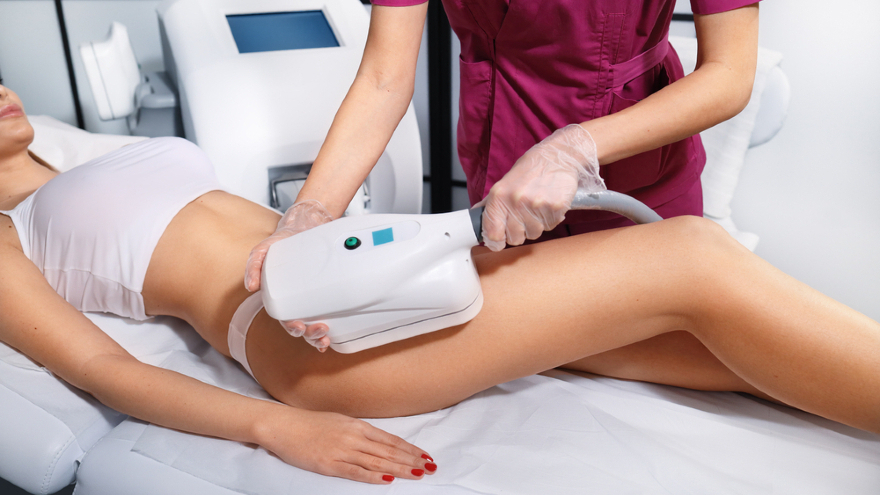
Depending on your case, revision may include one or more of the following:
High-Frequency Liposuction
Used to gently remove irregular fat deposits or overfilled zones. At Dite, we use water-assisted and ultrasonic liposuction tools to minimize trauma while refining the surrounding shape — essential when correcting boxy or asymmetric hips.
Fat Grafting with Structural Layering
Fat is harvested using low-pressure techniques to keep cells viable, then injected in multiple tissue planes for even distribution and long-lasting volume.
Unlike typical fat grafting, we perform layered placement from deep subcutaneous to superficial zones — almost like laying down soft contours with a sculptor’s hand.
Scar Tissue Release
If hard bands or indentations are present (especially near the trochanter or lateral thigh), we use internal tissue release techniques to free up tethered skin, allowing new fat to settle more naturally.
Hip-Glute Harmony Adjustment
In some cases, the original surgery created hip volume without addressing adjacent areas like the gluteus medius or lower waist. We correct this by expanding the aesthetic unit — sometimes adding volume to the upper buttock or reducing love handle fat for better flow.
What Patients Often Don’t Know (But Should)
Here are a few truths we wish more patients understood before choosing — or correcting — hip surgery:
- Not all fat survives. A high resorption rate (over 50%) usually means poor technique or overfilling. With proper fat handling and placement, we typically retain 70–80% of grafted volume.
- Symmetry isn’t automatic. Your natural hip bones may be uneven — a good surgeon must work around this to visually balance both sides.
- The first result is rarely the final one. Even successful revisions take 3–6 months to fully settle. Some patients benefit from a staged approach for the most refined result.
- It’s not always about adding. Sometimes the best improvement comes from subtracting — slimming a bulky outer thigh or correcting a distorted waist-to-hip ratio.
Real Case: From Flat and Uneven to Soft and Balanced
One patient came to us after two failed hip grafts done abroad. Despite receiving over 500cc of fat per side, her hips remained flat, with visible irregularities and scar nodules on one side. Worse, the transition between her waist and hips felt abrupt and artificial.
We approached her case with:
- Internal release of scarred fat planes
- Precision fat harvesting from the thighs and back
- 180cc micro-grafting per side, sculpted along the hip dip and upper lateral hip
- Waist contouring for proportional flow
At 6 months post-op, the result was a subtle, natural hourglass — not exaggerated, but harmonized, with no signs of past scarring or artificial bulk.
Can Hip Shape Be Fully Corrected?
In most cases — yes. While we can’t change your bone structure, we can reshape your soft tissue contour to create the illusion of balance, symmetry, and curve. Results depend on:
- The quality of existing tissue
- How much fat is available
- Whether the original surgery caused internal damage
But even in difficult cases, the difference between a poorly executed hip surgery and a properly revised one is dramatic.
Trust Matters in Revision Surgery

Revision isn’t about quick fixes — it’s about restoring confidence and correcting what others overlooked. At Dite Plastic Surgery, Dr. Jun Wook Lee approaches revision with the same care as first-time surgeries, using:
- Detailed 3D planning
- Custom fat mapping
- Gentle, layered techniques that preserve tissue health
We don’t aim for exaggerated “Instagram curves.” We focus on clean, smooth proportions that feel authentic to your body — because confidence doesn’t come from size alone, but from balance.
Considering a Hip Revision?
If you’ve had disappointing results from a previous hip surgery — whether due to volume loss, asymmetry, or unnatural shape — know that correction is possible.
A personal consultation with Dr. Lee at Dite Plastic Surgery can help you understand:
- What went wrong
- What can be improved
- And how to achieve a refined, lasting result
Ready to reclaim your shape? Book your private evaluation at Dite — where body contouring isn’t just surgery, it’s an art of restoration.
Articles
Evidence-based surgical guides, clinical insights, and recovery resources from Dite Plastic Surgery.

The Top 5 Benefits of Hip Implant Surgery
"Discover the top 5 benefits of hip implant surgery, from pain relief to improved mobility. Learn how it can enhance your quality of life today!"
Learn More

The Risks and Benefits of Hip Revision Surgery Explained
Discover the risks and benefits of hip revision surgery, from recovery to outcomes, to make informed decisions. Learn more today!
Learn More

Why Abdominal Surgery Is the Ultimate Solution for Stubborn Belly Fat
Discover why abdominal surgery is the best solution for stubborn belly fat. Learn benefits, risks & results to achieve your dream body today!
Learn More